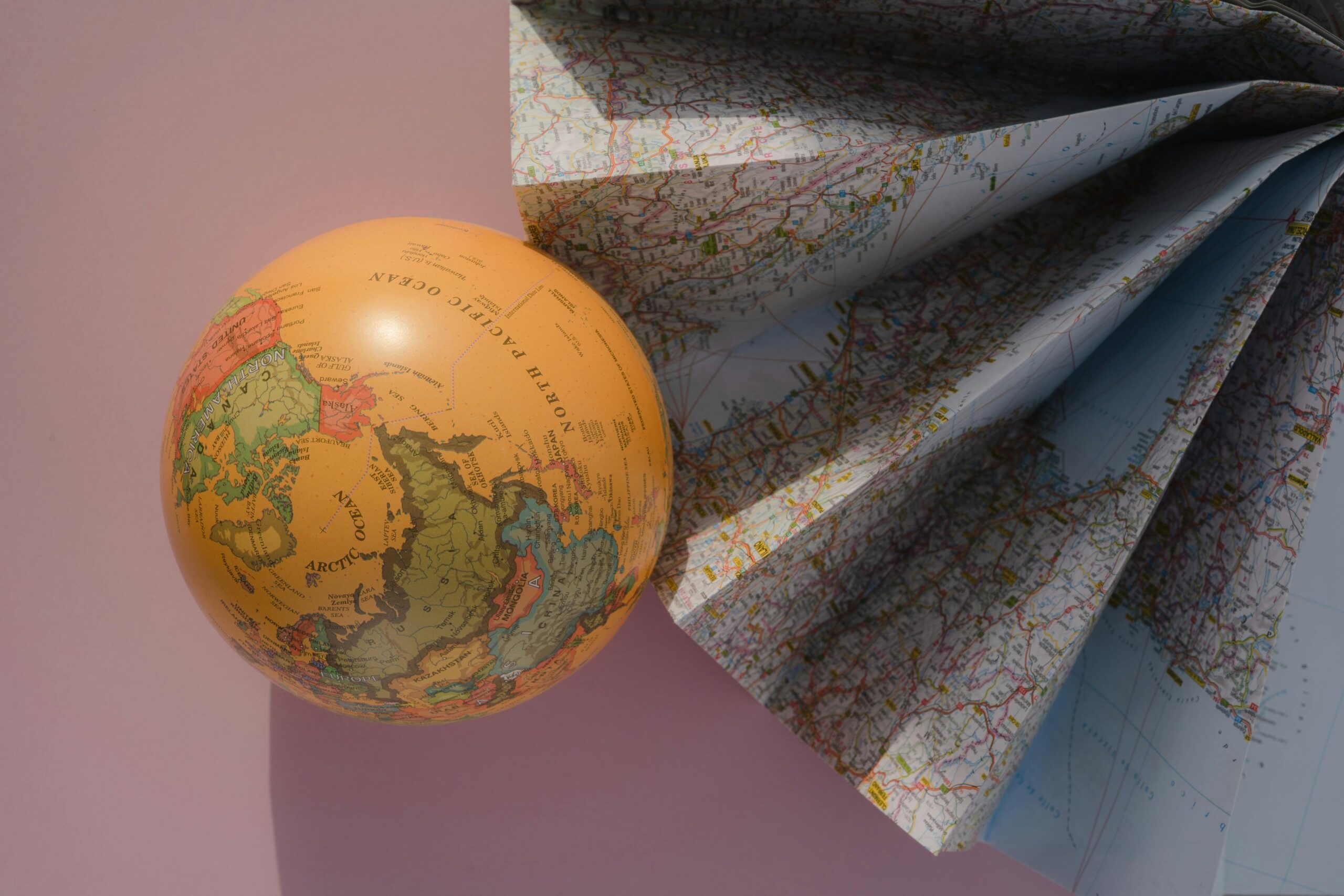
In 1943, the architect and systems thinker R. Buckminster Fuller unveiled something that quietly challenged the way every person on Earth understood the world — including themselves. He called it the Dymaxion Map: a projection of the planet onto an unfolded icosahedron that, for the first time, depicted Earth’s landmasses without the familiar distortions of the standard Mercator projection.
There was no “top.” No dominant hemisphere. No subtle suggestion that some parts of the world were larger, more central, or more important than others. Just one continuous landmass floating in a sea, with no fixed orientation and no built-in hierarchy.
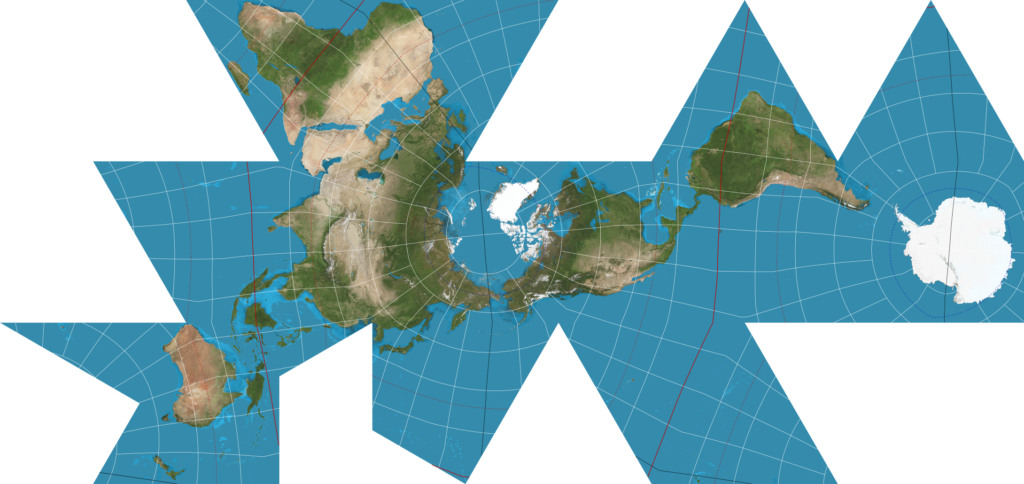
It was, in Fuller’s words, a map of Spaceship Earth — a planet that belonged to all of its inhabitants equally.
What Fuller may not have fully articulated — but what psychology has since come to understand — is that maps are never just geographic. They are cognitive. They shape how we think, who we believe we are, and what we unconsciously assume about our place in the world. And the standard map most of us grew up with has been quietly distorting our psychology for centuries.
Maps as Mental Models
Long before GPS made navigation effortless, maps were among the most powerful tools for shaping human consciousness. A map doesn’t just tell you where things are. It tells you what matters, what’s central, and what belongs at the edges. It encodes a worldview.
The Mercator projection, developed in 1569 and still the most widely used map today, was designed for maritime navigation. It accurately preserves angles, which makes it useful for sailing. But it dramatically distorts size — inflating landmasses closer to the poles and shrinking those near the equator. The result is a map where Europe appears roughly the same size as South America, when in reality South America is nearly twice as large. Where Greenland looks comparable to Africa, when Africa is actually fourteen times bigger.
For five centuries, billions of people have absorbed this distortion as reality. And in doing so, they have absorbed — unconsciously — a particular story about which parts of the world are significant.
In psychology, we call this kind of invisible, inherited assumption a cognitive schema: a mental framework that filters perception and shapes behavior without our awareness. We don’t question it because we never learned to see it as a choice.
The Dymaxion Map disrupts that schema. And disruption, in psychology, is often where growth begins.
The Psychology of “Center” and “Periphery”
One of the most powerful — and most psychologically loaded — features of any map is what it places at the center.
The center of a map is unconsciously interpreted as the center of importance. It’s where the eye rests. It’s the reference point from which everything else is measured. In the standard world map, Europe and the North Atlantic occupy this position. The Americas are split and pushed to the edges. The Global South is diminished. The Pacific — the largest ocean on Earth — is typically bisected and assigned to the margins.
These are not neutral choices. They reflect the worldview of the cartographers who made them, the empires that commissioned them, and the educational systems that reproduced them.
Psychologists who work with cross-cultural populations — including expats, immigrants, refugees, and digital nomads — frequently encounter the psychological residue of these assumptions. Clients from the Global South often describe an internalized sense of coming from somewhere “less than,” even when they cannot trace that belief to any explicit message. Clients from dominant cultural backgrounds often carry an unexamined assumption that their frame of reference is the default — that their way of experiencing the world is simply the way.
The Dymaxion Map, by refusing to assign center or periphery, offers a visual metaphor for something that therapy often works toward: the decentering of a single perspective as the measure of all things.
Fuller’s Vision and the Psychology of Interconnection
Fuller didn’t design the Dymaxion Map purely as a cartographic exercise. He was interested in systems thinking — in the idea that the world’s problems, and the world’s possibilities, could only be properly understood by seeing the planet as an integrated whole rather than a collection of competing territories.
His concept of Spaceship Earth was fundamentally about interconnection: the recognition that all of humanity shares a single, finite vessel, and that the divisions we draw between nations, cultures, and peoples are, at the level of planetary reality, arbitrary.
This is a profoundly psychological insight — and one that resonates deeply with therapeutic work on identity, belonging, and cultural dislocation.
Many of the clients I work with — expats, digital nomads, bilingual individuals, people who have built their lives across more than one culture — carry what I think of as a multi-map mind: a psychological orientation shaped by more than one worldview, more than one set of norms, more than one definition of what a good life looks like. This can be a source of profound richness. It can also be a source of deep confusion.
When you’ve lived between cultures, the comforting certainty of a single center dissolves. You see, from personal experience, that the rules you grew up with were never universal — just local. That the map you were handed was never the territory.
Fuller understood this at a planetary scale. Depth psychology understands it at the individual scale. And the intersection of the two is, I believe, one of the most fertile territories in contemporary mental health work.
Cognitive Maps, Therapy, and the Limits of Our Inherited Worldviews
The concept of a cognitive map — a mental representation of one’s environment and one’s place within it — was introduced by psychologist Edward Tolman in 1948, just five years after Fuller unveiled the Dymaxion Map. Tolman demonstrated that rats navigating a maze weren’t just following conditioned paths; they were building internal representations of space that they could use flexibly.
Humans do the same thing — not just for physical spaces, but for social, cultural, and emotional landscapes. We build internal maps of how the world works, who we are within it, what we are allowed to want, and what is possible for people “like us.”
Like the Mercator projection, these internal maps are usually inherited rather than chosen. We absorb them from family, culture, education, and experience — and then navigate by them for decades without questioning their accuracy.
Therapy, at its core, is often a process of cartographic revision: examining the maps we’ve been using, identifying the distortions, and — where necessary — drawing something more accurate, more useful, or more genuinely our own.
This is especially true for people who have lived across cultures. The expat who discovers that the career values they’ve been optimizing for were their parents’ values, not their own. The digital nomad who realizes that the restlessness driving their movement is a map drawn in childhood, not a true north. The bilingual client who finds that different languages access different emotional territories — different maps of the self.
(If this resonates and you’re a digital nomad questioning the psychological cost of constant movement, you might find this article useful: Digital Nomad Mental Health: The Hidden Cost of a Life Without Borders)
What It Means to Live Without a Fixed Center
There is a particular kind of disorientation that comes from leaving the map you grew up with — literally and psychologically. When you move abroad, change careers, end a long relationship, or simply start asking different questions about your life, the familiar landmarks disappear. What used to orient you no longer does.
This can feel like crisis. It can manifest as anxiety, identity confusion, or a nagging sense that you’re somehow lost.
But there’s another way to hold it — one that Fuller’s map quietly suggests. What if being without a fixed center isn’t a problem to be solved, but a more accurate description of reality? What if the absence of a single dominant orientation is not disorientation, but a truer kind of freedom?
The Dymaxion Map doesn’t tell you where the top is. It asks you to find your own orientation — to choose, consciously and intentionally, the perspective from which you’ll navigate.
That, in many ways, is also what good therapy invites.
A Different Kind of Map
Buckminster Fuller believed that humanity’s problems were largely problems of perception — that we were making decisions based on outdated, distorted, and artificially limited pictures of reality. Change the map, he suggested, and you change the thinking. Change the thinking, and you change what’s possible.
Psychology, at its best, operates on the same premise. The maps we carry — about ourselves, about belonging, about what we are worth and what we are capable of — determine the lives we build. Bringing those maps into awareness, questioning their distortions, and revising them where necessary is not a small undertaking. But it is one of the most important things a person can do.
If you’re living between worlds — as an expat, a digital nomad, or simply someone who has outgrown the map you were handed — and you’re finding that the old orientations no longer serve you, that’s not a sign that something is wrong with you.
It may be a sign that you’re ready for a more accurate map.
Work With a Psychologist Who Thinks in Systems
My name is Juan José Cassinelli, and I work online with expats, digital nomads, and people navigating the psychological complexity of lives lived across cultures, borders, and identities.
I’m interested in the deep questions: not just symptom relief, but the worldview revision that makes lasting change possible. If that kind of work appeals to you, I’d love to hear from you.
Sessions available in English and Spanish, flexible across time zones.