
Author: Juan Jose Cassinelli | Psychologist | juanjocassinelli.com

  • The Dymaxion Map and the Psychology of Worldview: What Buckminster Fuller Knew About the Mind

    The Dymaxion Map and the Psychology of Worldview: What Buckminster Fuller Knew About the Mind


    In 1943, the architect and systems thinker R. Buckminster Fuller unveiled something that quietly challenged the way every person on Earth understood the world — including themselves. He called it the Dymaxion Map: a projection of the planet onto an unfolded icosahedron that, for the first time, depicted Earth’s landmasses without the familiar distortions of the standard Mercator projection.

    There was no “top.” No dominant hemisphere. No subtle suggestion that some parts of the world were larger, more central, or more important than others. Just one continuous landmass floating in a sea, with no fixed orientation and no built-in hierarchy.
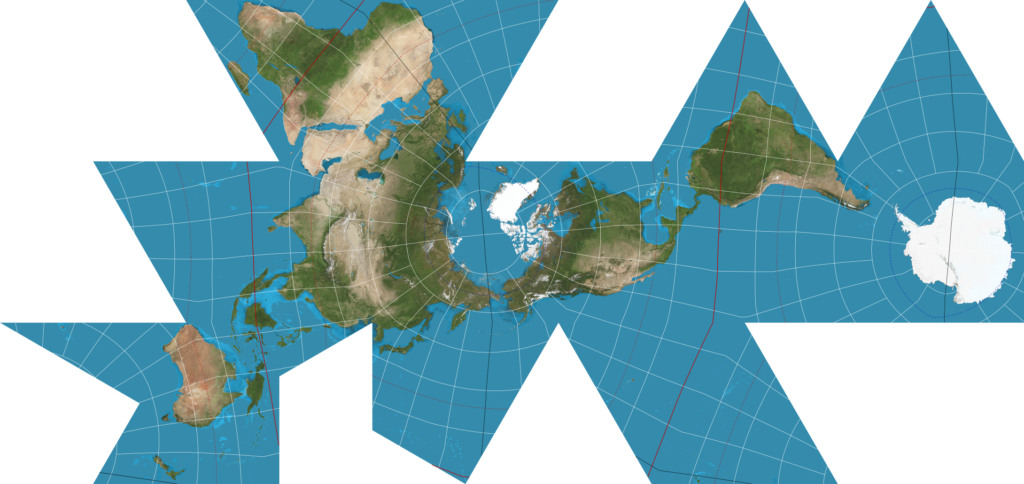
    It was, in Fuller’s words, a map of Spaceship Earth — a planet that belonged to all of its inhabitants equally.

    What Fuller may not have fully articulated — but what psychology has since come to understand — is that maps are never just geographic. They are cognitive. They shape how we think, who we believe we are, and what we unconsciously assume about our place in the world. And the standard map most of us grew up with has been quietly distorting our psychology for centuries.


    Maps as Mental Models

    Long before GPS made navigation effortless, maps were among the most powerful tools for shaping human consciousness. A map doesn’t just tell you where things are. It tells you what matters, what’s central, and what belongs at the edges. It encodes a worldview.

    The Mercator projection, developed in 1569 and still the most widely used map today, was designed for maritime navigation. It accurately preserves angles, which makes it useful for sailing. But it dramatically distorts size — inflating landmasses closer to the poles and shrinking those near the equator. The result is a map where Europe appears roughly the same size as South America, when in reality South America is nearly twice as large. Where Greenland looks comparable to Africa, when Africa is actually fourteen times bigger.

    For five centuries, billions of people have absorbed this distortion as reality. And in doing so, they have absorbed — unconsciously — a particular story about which parts of the world are significant.

    In psychology, we call this kind of invisible, inherited assumption a cognitive schema: a mental framework that filters perception and shapes behavior without our awareness. We don’t question it because we never learned to see it as a choice.

    The Dymaxion Map disrupts that schema. And disruption, in psychology, is often where growth begins.


    The Psychology of “Center” and “Periphery”

    One of the most powerful — and most psychologically loaded — features of any map is what it places at the center.

    The center of a map is unconsciously interpreted as the center of importance. It’s where the eye rests. It’s the reference point from which everything else is measured. In the standard world map, Europe and the North Atlantic occupy this position. The Americas are split and pushed to the edges. The Global South is diminished. The Pacific — the largest ocean on Earth — is typically bisected and assigned to the margins.

    These are not neutral choices. They reflect the worldview of the cartographers who made them, the empires that commissioned them, and the educational systems that reproduced them.

    Psychologists who work with cross-cultural populations — including expats, immigrants, refugees, and digital nomads — frequently encounter the psychological residue of these assumptions. Clients from the Global South often describe an internalized sense of coming from somewhere “less than,” even when they cannot trace that belief to any explicit message. Clients from dominant cultural backgrounds often carry an unexamined assumption that their frame of reference is the default — that their way of experiencing the world is simply the way.

    The Dymaxion Map, by refusing to assign center or periphery, offers a visual metaphor for something that therapy often works toward: the decentering of a single perspective as the measure of all things.


    Fuller’s Vision and the Psychology of Interconnection

    Fuller didn’t design the Dymaxion Map purely as a cartographic exercise. He was interested in systems thinking — in the idea that the world’s problems, and the world’s possibilities, could only be properly understood by seeing the planet as an integrated whole rather than a collection of competing territories.

    His concept of Spaceship Earth was fundamentally about interconnection: the recognition that all of humanity shares a single, finite vessel, and that the divisions we draw between nations, cultures, and peoples are, at the level of planetary reality, arbitrary.

    This is a profoundly psychological insight — and one that resonates deeply with therapeutic work on identity, belonging, and cultural dislocation.

    Many of the clients I work with — expats, digital nomads, bilingual individuals, people who have built their lives across more than one culture — carry what I think of as a multi-map mind: a psychological orientation shaped by more than one worldview, more than one set of norms, more than one definition of what a good life looks like. This can be a source of profound richness. It can also be a source of deep confusion.

    When you’ve lived between cultures, the comforting certainty of a single center dissolves. You see, from personal experience, that the rules you grew up with were never universal — just local. That the map you were handed was never the territory.

    Fuller understood this at a planetary scale. Depth psychology understands it at the individual scale. And the intersection of the two is, I believe, one of the most fertile territories in contemporary mental health work.


    Cognitive Maps, Therapy, and the Limits of Our Inherited Worldviews

    The concept of a cognitive map — a mental representation of one’s environment and one’s place within it — was introduced by psychologist Edward Tolman in 1948, just five years after Fuller unveiled the Dymaxion Map. Tolman demonstrated that rats navigating a maze weren’t just following conditioned paths; they were building internal representations of space that they could use flexibly.

    Humans do the same thing — not just for physical spaces, but for social, cultural, and emotional landscapes. We build internal maps of how the world works, who we are within it, what we are allowed to want, and what is possible for people “like us.”

    Like the Mercator projection, these internal maps are usually inherited rather than chosen. We absorb them from family, culture, education, and experience — and then navigate by them for decades without questioning their accuracy.

    Therapy, at its core, is often a process of cartographic revision: examining the maps we’ve been using, identifying the distortions, and — where necessary — drawing something more accurate, more useful, or more genuinely our own.

    This is especially true for people who have lived across cultures. The expat who discovers that the career values they’ve been optimizing for were their parents’ values, not their own. The digital nomad who realizes that the restlessness driving their movement is a map drawn in childhood, not a true north. The bilingual client who finds that different languages access different emotional territories — different maps of the self.

    (If this resonates and you’re a digital nomad questioning the psychological cost of constant movement, you might find this article useful: Digital Nomad Mental Health: The Hidden Cost of a Life Without Borders)


    What It Means to Live Without a Fixed Center

    There is a particular kind of disorientation that comes from leaving the map you grew up with — literally and psychologically. When you move abroad, change careers, end a long relationship, or simply start asking different questions about your life, the familiar landmarks disappear. What used to orient you no longer does.

    This can feel like crisis. It can manifest as anxiety, identity confusion, or a nagging sense that you’re somehow lost.

    But there’s another way to hold it — one that Fuller’s map quietly suggests. What if being without a fixed center isn’t a problem to be solved, but a more accurate description of reality? What if the absence of a single dominant orientation is not disorientation, but a truer kind of freedom?

    The Dymaxion Map doesn’t tell you where the top is. It asks you to find your own orientation — to choose, consciously and intentionally, the perspective from which you’ll navigate.

    That, in many ways, is also what good therapy invites.


    A Different Kind of Map

    Buckminster Fuller believed that humanity’s problems were largely problems of perception — that we were making decisions based on outdated, distorted, and artificially limited pictures of reality. Change the map, he suggested, and you change the thinking. Change the thinking, and you change what’s possible.

    Psychology, at its best, operates on the same premise. The maps we carry — about ourselves, about belonging, about what we are worth and what we are capable of — determine the lives we build. Bringing those maps into awareness, questioning their distortions, and revising them where necessary is not a small undertaking. But it is one of the most important things a person can do.

    If you’re living between worlds — as an expat, a digital nomad, or simply someone who has outgrown the map you were handed — and you’re finding that the old orientations no longer serve you, that’s not a sign that something is wrong with you.

    It may be a sign that you’re ready for a more accurate map.


    Work With a Psychologist Who Thinks in Systems

    My name is Juan José Cassinelli, and I work online with expats, digital nomads, and people navigating the psychological complexity of lives lived across cultures, borders, and identities.

    I’m interested in the deep questions: not just symptom relief, but the worldview revision that makes lasting change possible. If that kind of work appeals to you, I’d love to hear from you.

    Sessions available in English and Spanish, flexible across time zones.

    👉 juanjocassinelli.com


  • Digital nomad mental health: The hidden cost of a life without borders.

    Digital nomad mental health: The hidden cost of a life without borders.


    The digital nomad lifestyle sells a dream: work from anywhere, answer to no one, collect passport stamps instead of office hours. And for many people, it genuinely delivers — at least for a while. But there’s a side of nomadic life that doesn’t make it into the travel blogs: the creeping loneliness, the identity drift, the anxiety that hides beneath the freedom.

    Digital nomad mental health is one of the least talked-about aspects of location-independent work — and one of the most important. If you’ve been feeling like something is off beneath the surface of a life that looks enviable from the outside, you’re not alone, and you’re not failing. You might just be overdue for an honest conversation about what this lifestyle is actually costing you.


    The freedom paradox.

    Freedom is exhausting.

    When nothing is fixed — not your city, your routine, your social circle, or your sense of home — your nervous system never fully relaxes. You’re always in a low-grade state of novelty and adjustment, which is stimulating at first and quietly depleting over time.

    Psychologists call this decision fatigue and chronic uncertainty. When every variable in your life is in flux simultaneously — where to live, where to work, which visa to apply for, whether to stay or move on — your brain is working overtime just to maintain baseline stability. That’s before you’ve done a single hour of actual work.

    The freedom to live anywhere can, paradoxically, leave you feeling like you belong nowhere.


    What digital nomad mental health actually looks like.

    The mental health challenges that show up most often for digital nomads aren’t always dramatic. They tend to be subtle, persistent, and easy to rationalize away:

    Chronic low-level loneliness. You meet people constantly — in coworking spaces, hostels, Slack communities, Airbnb lobbies. But surface-level connection isn’t the same as being known. When every relationship is temporary by design, it becomes hard to invest deeply in any of them. Over time, the result is a particular kind of loneliness that feels strange to admit when you’re technically never alone.

    Identity diffusion. Who are you when you’re untethered from the context that used to define you? No home city, no regular social circle, no physical place that holds your history. Many nomads find that after the initial exhilaration of reinvention, a quieter question emerges: Who am I, really?

    Productivity anxiety. The nomad lifestyle often blurs the line between work and life in ways that make rest feel like failure. When your laptop is always within reach and your income depends entirely on your output, it becomes very hard to stop. Many digital nomads quietly live with background anxiety about whether they’re doing enough — productive enough, earning enough, optimizing enough.

    Avoidance disguised as adventure. This one is harder to acknowledge. For some people, constant movement becomes a way of staying ahead of difficult emotions, unresolved relationships, or questions they’re not ready to sit with. The next destination always promises a fresh start. But the internal landscape tends to travel with you.

    The “I chose this” guilt. Just like expats, digital nomads often feel they’ve forfeited the right to complain. After all, you designed this life. Admitting that it’s hard can feel like ingratitude — or worse, like proof that you should just go back to a normal life. Neither is true.


    Why traditional therapy doesn’t work for nomads.

    The standard mental health system wasn’t built with digital nomads in mind. Most therapists are licensed to practice in a specific state or country — which means they legally can’t see you once you cross a border. Continuity of care, one of the most important factors in effective therapy, becomes nearly impossible when you’re moving every few weeks or months.

    Add to that the timezone chaos, the unreliable WiFi, the lack of a stable home address, and the sheer logistical difficulty of maintaining any consistent routine — and it’s easy to understand why so many digital nomads simply don’t get the support they need.

    This is exactly the gap that online therapy for digital nomads is designed to fill. A remote psychologist who works internationally, understands the nomadic lifestyle, and can offer flexible scheduling isn’t a compromise — it’s the right tool for the job.


    What therapy can do for a digital nomad.

    Working with a psychologist doesn’t mean slowing down or giving up the lifestyle. It means building enough internal stability to actually enjoy it.

    Some of the most valuable things therapy offers digital nomads:

    A consistent relationship in an inconsistent life. When everything around you is changing, a regular therapeutic relationship becomes an anchor — a space that stays the same regardless of which country you’re currently in.

    Tools for managing anxiety and uncertainty. Evidence-based approaches like Cognitive Behavioral Therapy (CBT) and Acceptance and Commitment Therapy (ACT) are especially useful for the kind of existential anxiety that nomadic life tends to produce.

    Honest reflection without judgment. Therapy offers something rare in nomad culture: a space where you don’t have to perform. No curated Instagram version of your life. No pressure to make it sound like an adventure. Just honesty about what’s actually going on.

    Help with the bigger questions. Many digital nomads eventually reach a point where the question shifts from where should I go next? to what do I actually want from my life? That’s not a crisis — it’s growth. And it’s exactly the kind of question that therapy is built for.


    When to reach out.

    You don’t need to be in crisis to benefit from therapy. But here are some signs that it might be worth having a conversation:

    • You’ve been feeling flat, anxious, or emotionally numb for longer than a few weeks
    • Loneliness is a persistent backdrop to your life, even when you’re surrounded by people
    • You’re struggling to focus, rest, or feel satisfied with your work
    • You find yourself moving on to the next place not out of excitement, but to escape something
    • You’re questioning whether this lifestyle is actually making you happy — and the question feels heavy

    Any of these is reason enough to reach out. You don’t have to have it all figured out before starting therapy. That’s what the therapy is for.


    Work with a psychologist built for your lifestyle.

    My name is Juan Jose Cassinelli, and I work entirely online with digital nomads, expats, and location-independent professionals navigating the psychological complexity of life without borders.

    I offer sessions in English and Spanish, with scheduling flexibility that genuinely accommodates time zone differences and nomadic routines. My approach is evidence-based, direct, and designed for people who think deeply about their lives and want support that matches that depth.

    The freedom to live anywhere is extraordinary. You deserve to actually feel free.

    👉 Visit juanjocassinelli.com to get in touch and schedule your first session.


  • Expat burnout: Why living abroad can exhaust you — and how therapy can help.

    Expat burnout: Why living abroad can exhaust you — and how therapy can help.


    You moved abroad for a reason. Maybe it was adventure, opportunity, love, or simply the need for a change. And for a while — maybe even a long while — it was everything you hoped for. But somewhere along the way, something shifted. The excitement faded. Simple things started feeling heavy. You’re tired in a way that sleep doesn’t fix, and you can’t quite explain it to the people back home who think your life looks amazing.

    What you might be experiencing is expat burnout — and it’s far more common than anyone talks about.


    What is Expat burnout?

    Burnout, broadly defined, is a state of chronic exhaustion caused by prolonged stress that hasn’t been adequately addressed. Most people associate it with work, but burnout is really about being depleted — emotionally, mentally, and sometimes physically — by demands that have consistently outpaced your capacity to recover.

    For expats, burnout has a particular texture. It isn’t just about working too hard (though that’s often part of it). It’s the accumulated weight of navigating a foreign environment every single day: speaking in a second language, decoding unfamiliar social norms, building community from scratch, managing the logistics of life abroad, and doing all of it while staying connected to the life and people you left behind.

    When you add up everything that expat life quietly demands of you, it’s not surprising that so many people eventually hit a wall.


    The hidden costs of living abroad.

    One of the reasons expat burnout goes unrecognized — even by the people experiencing it — is that the stressors are often invisible. They don’t look like hardship from the outside. But consider what daily life as an expat actually involves:

    Constant cognitive load. Even if you speak the local language fluently, navigating a foreign culture requires ongoing mental effort. Reading social cues, translating idioms, adjusting your communication style — these micro-adaptations are exhausting in ways that are hard to quantify.

    The performance of being fine. Many expats feel pressure to appear as if they’re thriving. To admit that you’re struggling feels like admitting failure — like you made the wrong choice, or you’re not cut out for this. So you perform wellness, even when you’re running on empty.

    Disconnection from your support network. The friends and family who know you best are in a different time zone. The people around you in your new country are still relative strangers. This gap — between needing support and not having easy access to it — is one of the most quietly painful aspects of expat life.

    Unprocessed grief. Moving abroad means leaving things behind: relationships, routines, a sense of belonging, a version of yourself. That’s loss, even when the move was your choice. And loss that goes unprocessed tends to accumulate.

    Uncertainty as a constant backdrop. Visa renewals, contract renewals, the possibility of having to move again. Many expats live with a low-level hum of instability that they’ve simply gotten used to — without realizing how much energy it costs them.


    Signs you may be experiencing Expat burnout.

    Burnout doesn’t usually arrive all at once. It creeps in gradually, and by the time most people recognize it, they’ve been running on fumes for months. Some of the most common signs include:

    • Feeling emotionally flat or detached, even from things that used to excite you
    • Persistent fatigue that doesn’t improve with rest
    • Increased irritability, impatience, or emotional reactivity
    • Withdrawing from social situations you previously enjoyed
    • A sense that everything requires more effort than it should
    • Difficulty concentrating or making decisions
    • Asking yourself, more and more often, “What’s the point?”
    • Fantasizing about going back home — not out of genuine desire, but out of desperation for relief

    If several of these resonate, that’s worth paying attention to. Burnout doesn’t resolve on its own. Left unaddressed, it tends to deepen.


    Why Expat burnout Is often misunderstood.

    There’s a particular kind of loneliness in expat burnout that comes from feeling like you shouldn’t be struggling. The people in your home country often can’t fully understand what you’re going through. And the people around you abroad may be projecting their own version of the expat experience — one that doesn’t match yours.

    Well-meaning responses like “But you live in such an amazing place!” or “You’re so brave — I could never do what you do” can make it harder to acknowledge how depleted you actually feel. Comparison and guilt become additional weights on top of an already heavy load.

    This is why working with a psychologist who genuinely understands expat life matters. Not just someone who has read about it — someone who can hold the full complexity of your experience without minimizing it or projecting onto it.


    How therapy helps with Expat burnout.

    Therapy for expat burnout isn’t about convincing you that things are fine, or pushing you to be more resilient. It’s about creating a space where you can finally stop performing and start being honest — with yourself and with someone else.

    In our work together, we focus on:

    Understanding the roots. Burnout is a symptom, not a diagnosis. We look underneath it — at the patterns, beliefs, and circumstances that have been quietly draining you — so we can address the actual source rather than just the surface.

    Rebuilding your relationship with rest and recovery. Many expats have unlearned how to rest. High-achievers especially tend to equate productivity with worth. Therapy helps you recalibrate.

    Reconnecting with what matters to you. Burnout often signals a misalignment between how you’re living and what you actually value. Clarifying that — and making intentional changes — is some of the most meaningful work we do.

    Processing grief and loss. The things you left behind deserve acknowledgment. Unprocessed grief is one of the most common hidden drivers of expat burnout.

    Building sustainable coping strategies. Not generic advice — real tools, tailored to your specific life, that actually work in the context of living abroad.


    You don’t have to wait until you’re completely depleted.

    One of the most important things I want you to know is this: you don’t have to reach rock bottom before seeking support. In fact, the earlier you address burnout, the more options you have.

    If you’ve been feeling tired, disconnected, or quietly hollow for a while — even if you can’t fully explain it — that’s enough reason to reach out.


    Work with a psychologist who understands your world.

    My name is Juan Jose Cassinelli, and I’m a psychologist working entirely online with expats, bilingual clients, and people navigating major life transitions. I offer sessions in English and Spanish, with flexible scheduling designed to work across time zones.

    I’m not here to tell you what you should feel or how your life abroad should look. I’m here to help you figure out what you actually need — and to support you in building something that’s genuinely sustainable.

    If expat burnout sounds familiar, let’s talk.

    👉 juanjocassinelli.com — reach out to schedule a first session or ask any questions you have.


  • Online therapy for Expats: How to find the right psychologist no matter where you live.

    Online therapy for Expats: How to find the right psychologist no matter where you live.


    Living abroad is one of the most exciting — and quietly difficult — things a person can do. New cities, new languages, new opportunities. But also: loneliness, identity confusion, relationship strain, and the strange grief of leaving a life behind. If you’re an expat who has been feeling overwhelmed, stuck, or simply not quite like yourself, online therapy for expats might be exactly what you’ve been looking for.

    This article will walk you through what expat mental health really looks like, why traditional therapy often falls short for people living abroad, and how to find an English-speaking psychologist online who truly understands your experience.


    Why Expats face unique mental health challenges.

    Moving to a new country doesn’t come with a guidebook for your emotions. From the outside, the expat life can look glamorous — and sometimes it genuinely is. But beneath the Instagram posts and the new apartment, many expats quietly struggle with:

    • Culture shock and identity loss. When the language, social rules, and daily rhythms around you are different, it can feel like you don’t quite know who you are anymore.
    • Isolation and loneliness. Building real friendships as an adult is hard. Building them in a foreign culture, often without a shared language, is even harder.
    • Relationship stress. Whether you moved as a couple, left a partner behind, or are navigating family dynamics across time zones, distance puts pressure on every relationship.
    • Career and purpose anxiety. Many expats find that professional credentials don’t transfer easily, or that the career path they had planned simply doesn’t exist in their new country.
    • The “should be grateful” trap. One of the most isolating experiences for expats is feeling that they shouldn’t be struggling — because, after all, they chose this life. This sense of guilt makes it harder to reach out for help.

    These challenges are real, valid, and remarkably common. You are not failing at being an expat. You are human.


    Why finding a therapist abroad is so hard.

    When you need support, the obvious answer is to look for a psychologist — but for expats, that’s rarely straightforward.

    Language barriers are the most immediate obstacle. Therapy requires nuance, vulnerability, and precision. Processing deep emotions in a second language is exhausting and limiting. Many expats find that the most important conversations — the ones about family, identity, fear, and grief — can only really happen in their mother tongue.

    Cultural mismatches are equally significant. A therapist who hasn’t lived abroad may not understand the specific texture of expat life: the longing for familiar food, the shame of a visa rejection, the complicated pride of raising bilingual children, or the grief of missing a parent’s final years from the other side of the world.

    Practical barriers add another layer. Local therapists may have long waitlists, charge in a currency that’s expensive for you, or simply not be available during hours that work across multiple time zones.

    This is exactly where remote therapy with a psychologist who specializes in expat mental health becomes not just convenient, but genuinely superior.


    What online therapy for Expats actually looks like.

    Remote therapy has come a long way. Sessions take place over secure video calls — think of it as a private, professional conversation from wherever you feel most comfortable, whether that’s your apartment in Berlin, a quiet café in Buenos Aires, or your home office in Dubai.

    A good online therapist who works with expats will:

    • Conduct sessions in your native language (or the language you think and feel in most deeply)
    • Understand cross-cultural transitions and the psychological complexity of living between two or more worlds
    • Offer flexible scheduling that works across time zones
    • Bring evidence-based tools — like Cognitive Behavioral Therapy (CBT), Acceptance and Commitment Therapy (ACT), or psychodynamic approaches — adapted to your specific situation
    • Work without judgment about the lifestyle choices that brought you abroad

    The goal isn’t just to manage symptoms. It’s to help you build a life that feels genuinely yours, wherever in the world you happen to be living it.


    Common issues we work on together.

    Every expat’s story is different, but in my practice I frequently support clients through:

    • Anxiety and chronic stress — especially the low-grade, constant kind that comes from navigating an unfamiliar environment every single day
    • Depression and emotional exhaustion — including the particular heaviness that comes from cultural isolation
    • Life transitions and identity questionsWho am I outside of my home country? What do I actually want from this life?
    • Relationship and communication difficulties — including couples navigating the strain of relocation together
    • Grief and loss — mourning a previous life, a relationship, or a version of yourself that got left behind
    • Burnout — especially among high-achieving professionals who moved abroad for career opportunities and are now running on empty

    You don’t need to arrive in crisis to benefit from therapy. Many of the most meaningful work happens in that quieter space of I know something isn’t right, but I can’t quite name it yet.


    How to choose the right online psychologist as an Expat.

    Not all therapists are equipped to work with expats, and not all online therapy platforms are the right fit either. Here are a few things to look for:

    1. Professional credentials. Make sure your therapist is a licensed psychologist, not just a life coach or wellness practitioner. Credentials vary by country, so look for a degree in psychology and verifiable professional registration.

    2. Experience with expats or cross-cultural clients. Ask directly: Have you worked with clients living abroad? Do you have personal experience with cross-cultural living? Lived experience matters in this context.

    3. A language that feels like home. If you need to stop and translate your emotions mid-session, you’re working harder than you should be. Choose a therapist who works in your native language or the one closest to your emotional vocabulary.

    4. A secure, confidential platform. Your sessions should be encrypted and private. Don’t accept anything less.

    5. A good fit. Most psychologists offer a brief introductory call. Use it. The therapeutic relationship is one of the strongest predictors of good outcomes — trust your gut.


    Why work with me.

    My name is Juan José Cassinelli, and I’m a psychologist specializing in remote therapy for expats, bilingual clients, and people navigating major life transitions.

    I work entirely online, which means I can support you wherever you are in the world. I bring both professional training and personal familiarity with the experience of navigating life across cultures. My approach is warm, direct, and deeply individualized — I’m not interested in one-size-fits-all solutions.

    I offer sessions in English and Spanish, and I work with adults on a wide range of concerns, from anxiety and relationship difficulties to identity, burnout, and existential questions about direction and meaning.

    You deserve support that actually fits your life — not a compromise.


    Ready to take the first step?

    If you’re an expat who has been considering therapy but hasn’t known where to start, I’d love to hear from you. The first step is simply a conversation.

    👉 Visit juanjocassinelli.com to learn more and get in touch.

    Sessions are available online, flexible across time zones, and conducted in English or Spanish. You don’t have to figure this out alone.